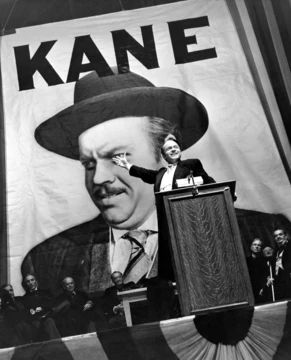
Citizen Kane
A film about the life and legacy of Charles Foster Kane.

Citizen Kane is a 1941 American motion picture that marked the feature film debut of Orson Welles. The quasi-biographical film examines the life and legacy of Charles Foster Kane, played by Welles, a fictional character based in part upon the American newspaper magnate William Randolph Hearst and Chicago tycoons Samuel Insull and Harold McCormick. A rich incorporation of the experiences and knowledge of its authors, the film earned an Academy Award for Best Writing (Original Screenplay) for Herman J. Mankiewicz and Welles.
- release_year
- 1941
- director
- Orson Welles
- country
- United States
- genre
- Drama
- academy_awards
- Best Writing (Original Screenplay)
Lore & Background
The sources for Citizen Kane have been the subject of speculation and controversy since the project's inception. With a story spanning 60 years, the film examines the life and legacy of Charles Foster Kane. Welles never confirmed a principal source for the character. John Houseman wrote that Kane is a synthesis of different personalities, with Hearst's life used as the main source: 'The truth is simple: for the basic concept of Charles Foster Kane and for the main lines and significant events of his public life, Mankiewicz used as his model the figure of William Randolph Hearst. To this were added incidents and details invented or derived from other sources.' Houseman adds that they 'grafted anecdotes from other giants of journalism, including Pulitzer, Northcliffe and Mank's first boss, Herbert Bayard Swope.' Welles said, 'Mr. Hearst was quite a bit like Kane, although Kane isn't really founded on Hearst in particular, many people sat for it so to speak.' He specifically acknowledged that aspects of Kane were drawn from the lives of Samuel Insull and Harold Fowler McCormick.
Reader's Guide
The film is commonly regarded as a fictionalized, unrelentingly hostile parody of William Randolph Hearst, in spite of Welles's statement that 'Citizen Kane is the story of a wholly fictitious character.' Film historian Don Kilbourne pointed out that much of the film's story is derived from aspects of Hearst's life that had already been published and that 'some of Kane's speeches are almost verbatim copies of Hearst's.' The most identifiable anecdote from Hearst's life used in the film is his famous but almost certainly apocryphal exchange with illustrator Frederic Remington. In January 1897 Remington was sent to Cuba by Hearst's New York Journal. Remington purportedly cabled Hearst from Havana that he wished to return since everything was quiet and there would be no war. Hearst is supposed to have replied, 'Please remain. You furnish the pictures, and I'll furnish the war.' Hearst biographer David Nasaw described Kane as 'a cartoon-like caricature of a man who is hollowed out on the inside, forlorn, defeated, solitary because he cannot command the total obedience, loyalty, devotion, and love of those around him.' Welles said that he had excised one scene from Mankiewicz's first draft that had certainly been based on Hearst. 'In the original script we had a scene based on a notorious thing Hearst had done, which I still cannot repeat for publication.'
Did You Know?
- As a model for the makeup design of the old Charles Foster Kane, Welles gave Maurice Seiderman a photograph of Chicago industrialist Samuel Insull, with mustache.
- In 1925, after a 26-year absence, Gladys Wallis Insull returned to the stage in a charity revival of The School for Scandal that ran two weeks in Chicago. Herman Mankiewicz — then the third-string theater critic for The New York Times — was assigned to review the production. Mankiewicz returned to the press room drunk and wrote only the first sentence of a negative review before passing out on his typewriter, an incident he resurrected in writing the screenplay for Citizen Kane.
- Like Kane, Harold McCormick was divorced by his aristocratic first wife, Edith Rockefeller, and lavishly promoted the opera career of his only modestly talented second wife, Ganna Walska.
- Welles cited financier Basil Zaharoff as another inspiration for Kane. 'I got the idea for the hidden-camera sequence in the Kane "news digest" from a scene I did on March of Time in which Zaharoff, this great munitions-maker, was being moved around in his rose garden, just talking about the roses, in the last days before he died,' Welles said.
- In her 1971 essay, 'Raising Kane,' film critic Pauline Kael wrote that a vestige of an abandoned subplot survives in a remark made by Susan Alexander Kane to the reporter: 'Look, if you're smart, you'll get in touch with Raymond. He's the butler. You'll learn a lot from him. He knows where all the bodies are buried.' Kael observed, 'In the first draft, Raymond literally knew where the bodies were buried: Mankiewicz had dished up a nasty version of the scandal sometimes referred to as the Strange Death of Thomas Ince.'
Origins and the Writing Partnership
The sources for Citizen Kane, the 1941 American motion picture that marked the feature film debut of Orson Welles, have been the subject of speculation and controversy since the project's inception. With a story spanning 60 years, the quasi-biographical film examines the life and legacy of Charles Foster Kane, played by Welles, a fictional character based in part upon the American newspaper magnate William Randolph Hearst and Chicago tycoons Samuel Insull and Harold McCormick. A rich incorporation of the experiences and knowledge of its authors, the film earned an Academy Award for Best Writing (Original Screenplay) for Herman J. Mankiewicz and Welles.
Building a Man from Many Faces
Welles never confirmed a principal source for the character of Charles Foster Kane. John Houseman, who worked with screenwriter Herman J. Mankiewicz on the early draft scripts, wrote that Kane is a synthesis of different personalities, with Hearst's life used as the main source. 'The truth is simple: for the basic concept of Charles Foster Kane and for the main lines and significant events of his public life, Mankiewicz used as his model the figure of William Randolph Hearst. To this were added incidents and details invented or derived from other sources.' Houseman adds that they 'grafted anecdotes from other giants of journalism, including Pulitzer, Northcliffe and Mank's first boss, Herbert Bayard Swope.' Welles said, 'Mr. Hearst was quite a bit like Kane, although Kane isn't really founded on Hearst in particular, many people sat for it so to speak.' He specifically acknowledged that aspects of Kane were drawn from the lives of two business tycoons familiar from his youth in Chicago — Samuel Insull and Harold Fowler McCormick.
The Shadow of Hearst
William Randolph Hearst was born rich. He was the pampered son of an adoring mother. Charles Foster Kane was born poor and was raised by a bank. The film is commonly regarded as a fictionalized, unrelentingly hostile parody of William Randolph Hearst, in spite of Welles's statement that 'Citizen Kane is the story of a wholly fictitious character.' Film historian Don Kilbourne has pointed out that much of the film's story is derived from aspects of Hearst's life that had already been published and that 'some of Kane's speeches are almost verbatim copies of Hearst's.' The most identifiable anecdote from Hearst's life used in the film is his famous but almost certainly apocryphal exchange with illustrator Frederic Remington. In January 1897 Remington was sent to Cuba by Hearst's New York Journal, to provide illustrations to accompany Richard Harding Davis's reporting about an uprising against Spain's colonial rule. Remington purportedly cabled Hearst from Havana that he wished to return since everything was quiet and there would be no war. Hearst is supposed to have replied, 'Please remain. You furnish the pictures, and I'll furnish the war.' Although Hearst denied the truth of the now legendary story, a milestone of yellow journalism, the ensuing Spanish–American War has been called 'Mr. Hearst's War.' One particular aspect of the character, Kane's profligate collecting of possessions, was directly taken from Hearst. 'And it's very curious – a man who spends his entire life paying cash for objects he never looked at,' Welles said. 'He just acquired things, most of which were never opened, remained in boxes. It's really a quite accurate picture of Hearst to that extent.' Xanadu was modeled after Hearst's large mansion Hearst Castle in San Simeon, California, which also had a private zoo and a large collection of art.
Welles's Defense and the Question of Public Life
Arguing for the release of Citizen Kane before the RKO board, Welles pointed out the irony that it was Hearst himself who had brought so much attention to the film being about him, and that Hearst columnist Louella Parsons was doing the most to publicize Kane's identification with Hearst. Public denials aside, Welles held the view that Hearst was a public figure and that the facts of a public figure's life were available for writers to reshape and restructure into works of fiction. Welles's legal advisor, Arnold Weissberger, put the issue in the form of a rhetorical question: 'Will a man be allowed in effect to copyright the story of his life?' Welles said that he had excised one scene from Mankiewicz's first draft that had certainly been based on Hearst. 'In the original script we had a scene based on a notorious thing Hearst had done, which I still cannot repeat for publication. And I cut it out because I thought it hurt the film and wasn't in keeping with Kane's character. If I'd kept it in, I would have had no trouble with Hearst. He wouldn't have dared admit it was him.'
Frequently Asked Questions
What is Citizen Kane about?
It is a 1941 American drama that traces the rise and fall of Charles Foster Kane, a powerful newspaper publisher whose life is examined through the eyes of a reporter. The film was directed by and starred Orson Welles in his feature-film debut.
Who is Charles Foster Kane based on?
The character is a fictional composite inspired by several real media and business magnates, most notably newspaper publisher William Randolph Hearst, along with Chicago industrialists Samuel Insull and Harold McCormick.
Why is Citizen Kane considered so important in film history?
It is widely regarded as a landmark that transformed how stories are told on screen, introducing groundbreaking techniques in depth of field, non-linear narrative, and layered sound design. Its influence on cinematography and editing shaped decades of filmmaking that followed.
What Academy Award did Citizen Kane win?
The film took home the Oscar for Best Writing (Original Screenplay), credited to Herman J. Mankiewicz and Orson Welles.
How does the Citizen Kane story end?
The film closes with a young boy finding a discarded glass snow globe from Kane's childhood and walking away, symbolizing the fleeting, ultimately ungraspable nature of the man's legacy.
More in Film History & Milestones 1-17
Spotted an error? Know more?
This is a living reference — every entry is fact-audited, and reader corrections feed straight into our audit queue. Suggest an edit · See this site's audit record